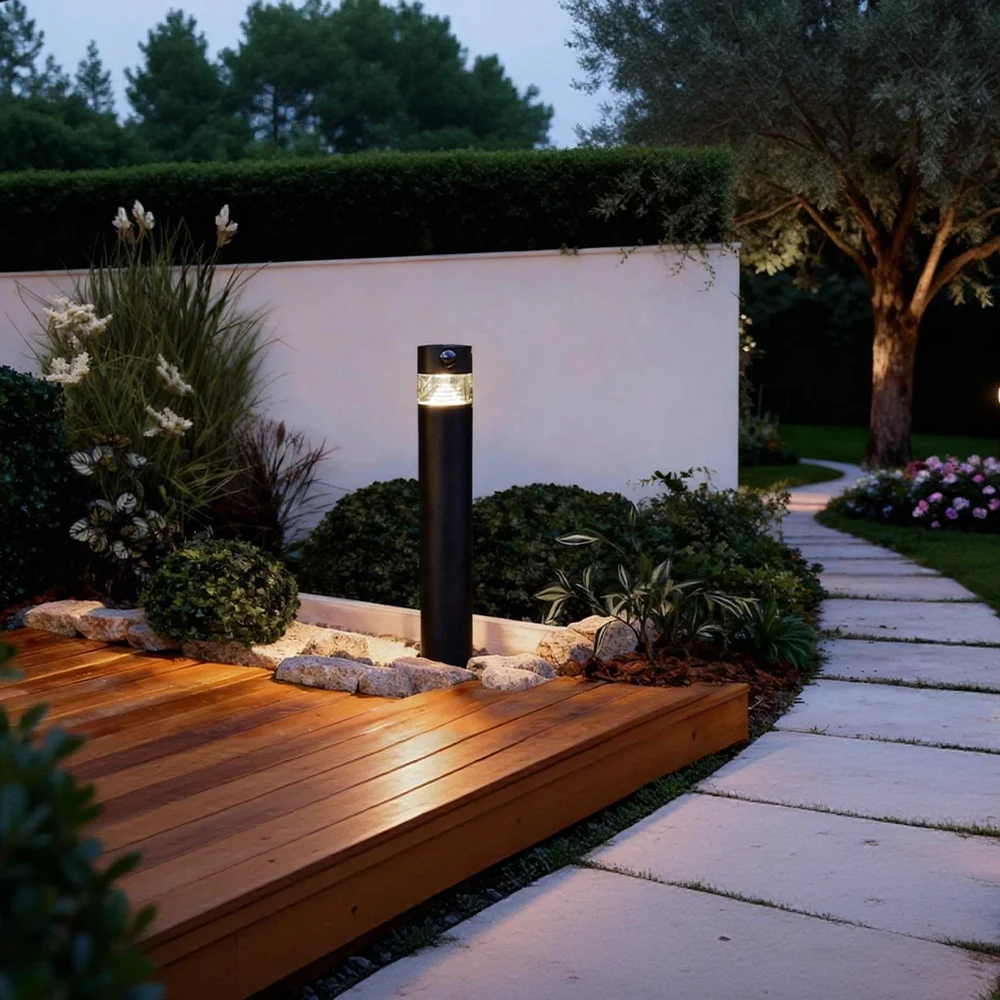
It is not enough to choose a beautiful solar applique to obtain an efficient and harmonious lighting. Still, we must know where to position it. A bad location can ruin all your efforts: persistent shadow zones, battery that struggles to recharge, disappointing visual rendering...
Good news: a few simple markers are enough to transform your outdoors. In this article, you will be told how to properly place your LED solar wall appliqués, depending on each concrete situation: terrace, entrance, garage, driveway...
Why choose a solar LED applicator?
The LED solar applicator is now a practical and elegant solution for theexterior lighting.
It works independently thanks to solar energy, avoiding electrical work or unsightly extension. It also offers excellent energy efficiency, without cost of operation. Add to this easy laying, design models and options such as motion sensors or reinforced sealing, and you have here an aesthetic, economical and ecological luminaire at the same time.
But now another crucial question arises: where exactly should they be placed? Because a poorly positioned app is ineffective lighting, persistent shadow zones, a battery that discharges badly... and a disappointment at the key.
Fortunately, there are some simple (but not always intuitive) rules to get the best out of your solar wall lighting. Whether it's for your terrace, a house entrance or along a garage, we guide you location by location.
On a terrace: create an atmosphere without blinding
A terrace requires a lighting of atmosphere, not a football stadium spot. You should avoid placing the applicators too high (at the risk of crushing the light) or too low (you will dazzle your guests sitting).
The right landmark?
Place the appliqués about 1.60 meters from the ground, either at face height. This allows a smooth and horizontal diffusion, perfect to create a warm atmosphere.
How much do you need?
Count one apply every 2.5 to 3 meters, depending on their power (400 to 600 lumens are enough for this type of space). The ideal is to alternate them with some light sources on the ground or on the table to vary the lighting levels.
"On a terrace, the classic mistake is to overlight. It's better to have a sieved effect, more comfortable to enjoy summer evenings," explains Christophe Coelho, founder of Lumihome.
Near an entrance: combining aesthetics and safety
Your entrance is the most frequented place... by you, your visitors, your delivery agents and sometimes mosquitoes. You need reliable, directional, but not aggressive lighting.
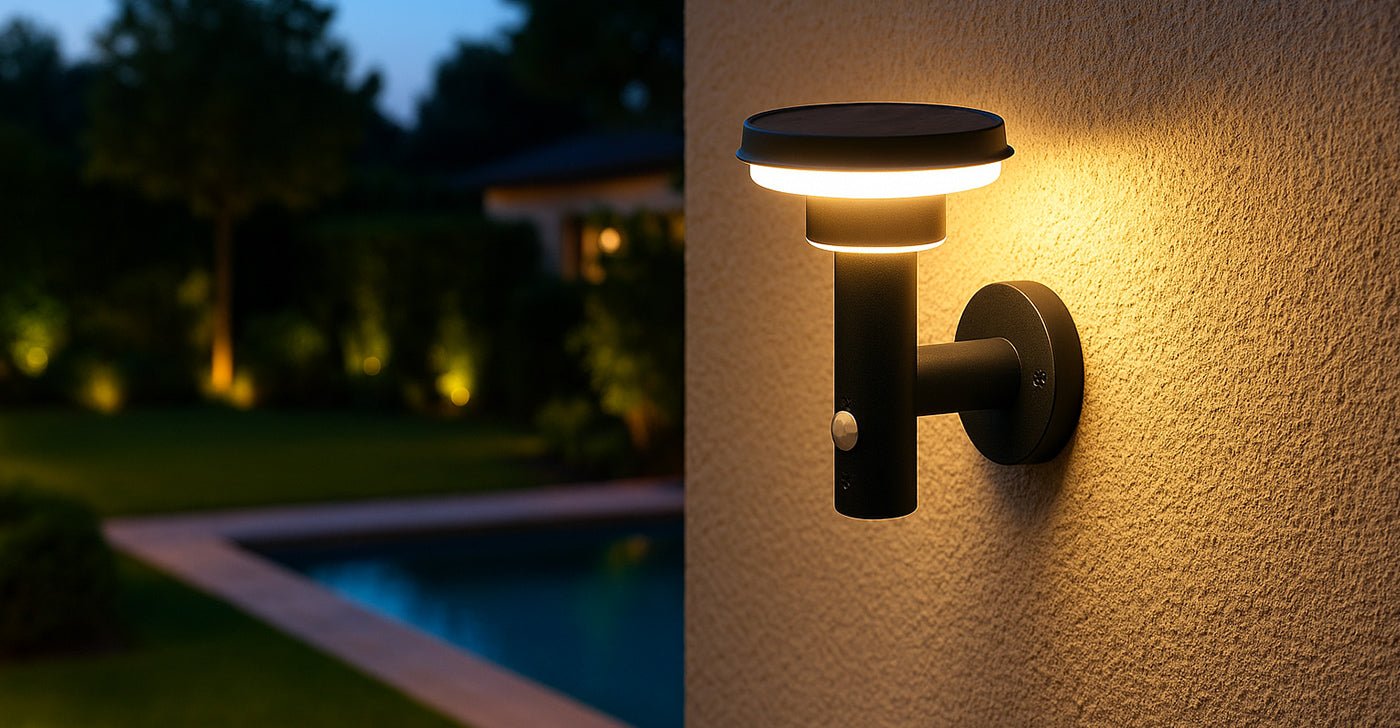
Recommended height: Between 1.70 and 2 meters, placed in order to illuminate the door handle and threshold. Ideally on the side of the door (or symmetrically on both sides if space allows).
Recommended power: between 600 and 800 lumens with motion sensor. This ensures a quick activation without leaving the area in the dark.
"Our solar appliqués with self-calibration detector are perfect for inputs: they only activate when it is useful, and remain off when you are not there, if you wish."
Along a garage: for visibility and handling
Whether it's to find your car key or to manoeuvre in reverse, the garage wall lighting needs to be clear, practical and wide.
Where to put them?
Install an applique on either side of the garage door, about 2 meters high. If your garage is double door, consider adding one to the center or above, for uniform lighting.
Recommended templates: High power (800 to 1000 lumens) with wide angle, reactive PIR detector and IP index greater than 44.
On the way or on the way: rhythm and safety
For a side road or a driveway, the objective is to effectively mark without too much light. It is here that the rhythm of implantation takes on its full meaning.
Ideal distance between the appliqués: between 2 and 3 meters, in five steps if possible. This avoids the effects of "light stains" too marked.
Half-height (1.30 to 1.50 m) to avoid overly vertical light projections and ensure good soil legibility.
"The important thing is regularity, not power, so we can light up to move, not to highlight a window."
Some tips for all cases
-
Optimize solar exposure: Always place the appliques on a wall that is well exposed (south or west) and free from obstacles such as the foregrounds or foliage.
-
Check the IP index: outdoors, plan a minimum of IP44, or even IP65 if your walls are directly exposed to the weather.
-
Think of the overall effect: even if you are installing several models, make sure a visual unit is set up by opting for consistent shapes, colors or heights.
And to conclude...
A well-selected applicator is good. But a well-placed applicator is even better. To effectively illuminate your exterior, give your luminaires the right location, angle and height.
And at Lumihome, all our models are designed for a simple pose, without electrician.
 DELIVERY €11, FREE FROM €150 OF PURCHASES IN FRANCE