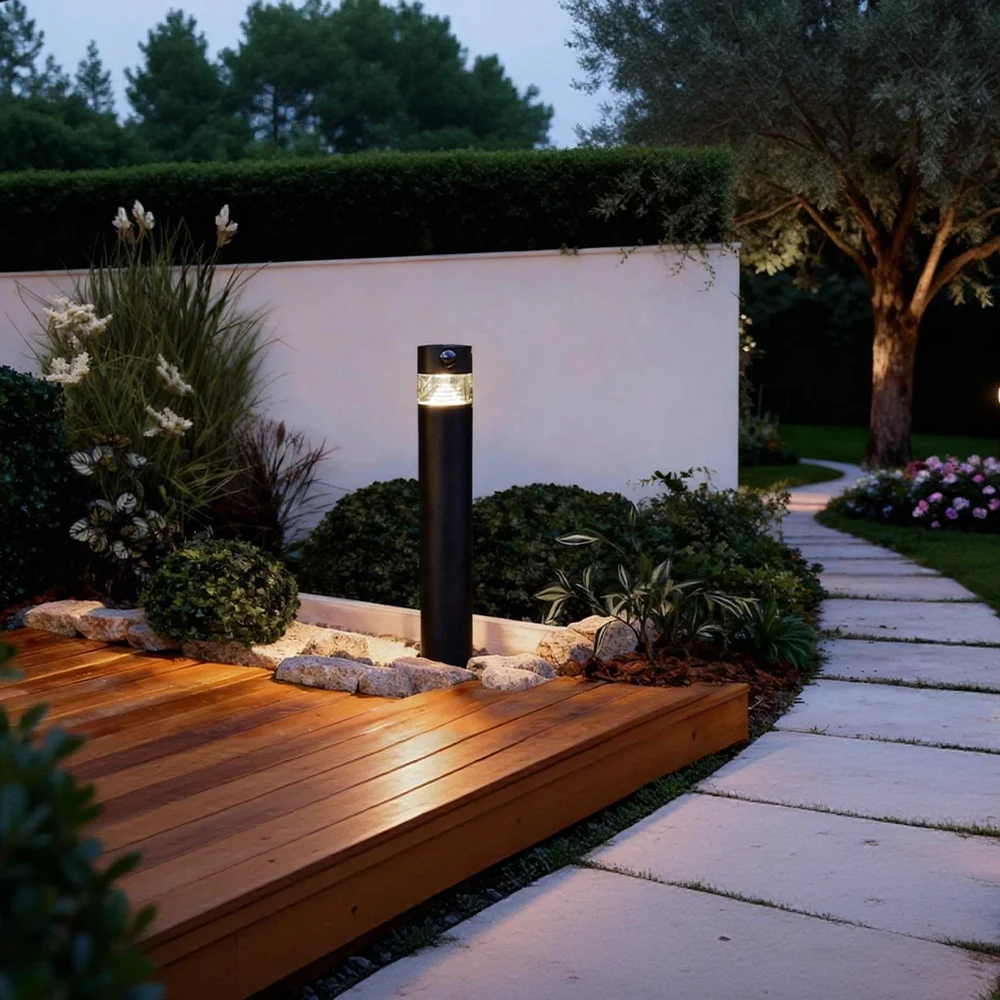
The installation of exterior lighting is not to be taken lightly. Before making your choice, you must consider many elements such as the aesthetic rendering of the luminaire or its power, but you must above all take into account the standards to be met. And yes, any outdoor electrical installation must meet a specific regulation that it is necessary to know before starting work. So, what does the standard say? What precautions should be taken to achieve exterior lighting safely? We take stock in this article.
Outdoor lighting: the specifics of NF C 15-100
The main rules to be followed
If you are considering lighting up your garden or dbrighten your terrace, you cannot ignore the NF C 15-100 standardIt is a French standard that regulates low voltage electrical installations. It sets the rules to be followed to ensure the safety of your electrical installation, the equipment used and the people. For example, NF C 15-100 requires that each luminaire be connected to the electrical panel by integrating a circuit breaker-type protection module. But this is not the only requirement of this standard which also requires:
- Installation of a 30mA differential switch in the main electrical panel. It can also be installed in a secondary panel connected to the phase, neutral and earth terminals of the main panel. This differential switch has the advantage of shutting off the current as soon as an overload, short circuit or concern appears.
- Use of luminaires suitable for outdoor use, i.e. sufficient for the purpose of IP.
- The arrival of each external circuit not connected to a luminaire, to a connection box. This can be equipped or not with a DCL base or a DCL lid.
- The creation of specialized circuits for all external power supplies not attached to the building, such as the electric gate.
- Positioning of the outside sockets at about a metre from the minimum ground.
- Installation of a lighting point for each entrance to the dwelling which will be controlled by a switch or presence detectors.
Rules for accessibility to persons with disabilities
The NF C 15-100 standard has been designed to cover all and everyone, since it also includes measures for persons with disabilities or mobility impairments, for example:
- External lighting shall emit a minimum of 20 lux at all points of travel.
- The control devices shall be equipped with a light and installed at a height between 0,90 and 1,30 metres above the ground and shall be positioned at an angle of 0,40 metres.
Outdoor lighting: zoom in on IP standard
IP standard: what is it?
As mentioned above, to make your lighting work, you must choose a luminaire suitable for outdoor use. To do this, you must check its resistance. In fact, the outdoor lamps are rarely in shelter. They are exposed to cold, frost, rain, but also to water projections of water, trampling of children and sometimes even at the passages of vehicles. To ensure the safety of people and the durability of your installation, you must rely on the IP standard and the protective index of your outdoor lamp.
The IP standard measures the degree of watertightness of your lighting. The protection index therefore represents the luminaire's resistance to water and dust. It is an international standard which is indicated on the packaging of each luminaire. You cannot miss it! Easy to understand, this index is composed of two digits: the first indicates the luminaire's resistance to solid body penetration. It is included on a scale ranging from 1 to 6. The second corresponds to water. It indicates the watertightness of the liquid bodies and is between 1 and 1 in the range. 9.
Which IP chooses for secure outdoor lighting?
First of all, it is important to know that the recommended minimum index for outdoor use is IP 44.
- L的IP 23: it protects the light device from light water sprays. You can opt for this index only if your luminaire is placed under cover.
- L
- L的IP 55: the luminaire is protected against dust and water jets from all directions.
- L-IP 65: the light device is protected from direct water projections.
- L的IP 67: it guarantees a temporary immersion seal.
- L的IP 68: this is the IP to be preferred for luminaires installed in the pool or basin since it guarantees a permanent immersion seal.
Good to know: Lumihome has developed a range of simple 12V luminaires to install, equipped with specific connectors and Easy Fix screwdriver system. They make it easy for you to install and save you the concerns of watertightness and safety that result from them.
The specifics of the buried pose
To connect an external electrical installation, the buried installation is often preferred. As a safety measure, it must also meet specific rules, namely:
- Cables with a sealing sheath and a steel wire armor can be placed in the open ground directly. However, cables without this armor must be installed in a TPC-type conduit in advance. If the diameter is less than 40 mm, you can also use ICCA or ICCL conduits.
- The cables must be buried 50 cm from the surface in the case of a garden. If it is a rotable land, then they must be installed 85 cm deep.
- The different conductors must be at a sufficient distance from the other pipes (water and gas for example). This distance must be at least 20 cm. If you do not use red TPC ducts, then you will have to install a red warning grill above your buried pipes.
The outdoor electrical installation does not simmer. Many elements are to be checked and respected for your safety and the durability of your installation. Don't hesitate to call a professional in case of doubts.
 DELIVERY €11, FREE FROM €150 OF PURCHASES IN FRANCE